What If AI in Management Isn't What You're Being Sold?
The five most common myths about AI in management and the questions worth asking a vendor before the project starts. A follow-up to the article about reports that come to you with the answer.
2026-11-26
In the previous article I described a Monday when problems find the manager on their own. It also had a short list of what such a system should not do. Here I will try to explain where that list comes from.
Everyone is talking about AI now. Vendors promise an “AI director”, an “autonomous business”, a bot in every department and payback in three months. Some of it is true, some of it is marketing. And some of it is simply a reliable way to spend your budget on a project that will be quietly shut down six months later.
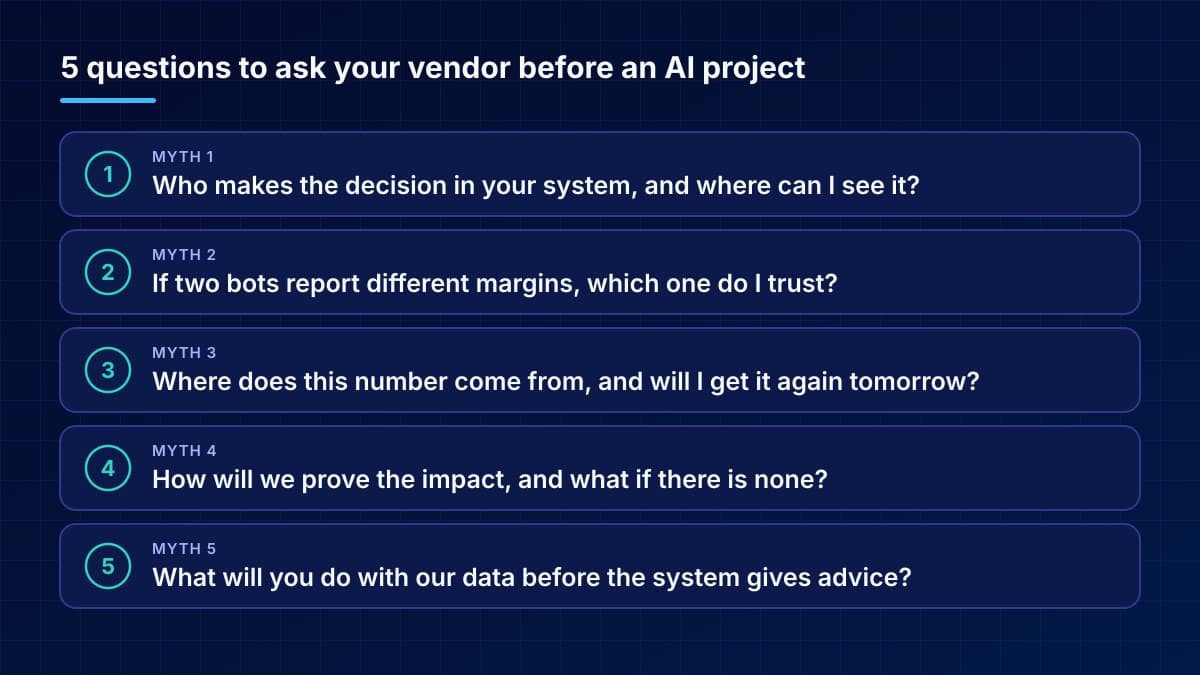
Below are the five myths I hear most often. For each one I added a question worth asking whoever is selling you this AI.
Myth 1. AI will replace the manager
Models really are good at writing, calculating and reasoning. So it seems the next step is to let them make the decisions too.
No. A manager's decision is more than a calculation. It means responsibility and context that is not in the data. The system does not know that a supplier promised special terms on the phone yesterday. And it will not be the one explaining to the owners why the decision did not work.
The right setup is different. AI collects the facts, checks the causes, calculates the options and says honestly where it might be wrong. A person decides, and the decision is recorded together with the reasoning.
Question for the vendor: who makes the decision in your system, and where can I see it?
Myth 2. Every department gets its own chatbot
Sounds logical: a bot for sales, a bot for finance, a bot for HR. Each one can be shown in a demo within a week.
Six months later you have five bots and five versions of the truth. The finance bot calculates margin with one formula, the sales bot with another. Access rights are set up differently, data is copied all over the place. It is the same “zoo” of systems companies have spent years getting away from. Only now with AI.
What works is one platform with shared data and the same definition for every metric. Roles differ: the director gets one thing, the buyer another. But margin is the same everywhere.
Question for the vendor: if the finance bot and the sales bot report different margins, which one do we trust?
Myth 3. The language model will calculate everything itself
Ask a model what the margin for a category was in October, and it will confidently give you a number. A plausible one. But plausible does not mean correct.
Language models work with text; they are not calculators. The same question can produce different numbers. And a mistake in a number wrapped in a nice paragraph is harder to spot than in a table. Management decisions need results that can be repeated and checked.
So we separate the work. Numbers are calculated by analytics: data queries, formulas, forecasting models. The language model explains the result in plain language. It can write “margin fell because the purchase price went up”, but it does not invent the margin itself.
Question for the vendor: where does this number come from, and will I get the same one tomorrow?
Myth 4. ROI is known in advance
The commercial offer says “20% less inventory” or “payback in six months”. The number is specific, so someone must have calculated it. Sometimes they actually did.
I would not rush. The impact depends on your data, processes and people. Someone else's case cannot predict your result. And most importantly: if you do not record how things were before the start, you cannot prove the impact even after launch. Shortages went down. Was it the system, the season or a new supplier?
So before the start we record the baseline: forecast accuracy, shortages, overstock, time spent searching for problems. Then we compare the system's recommendations with people's decisions, and the pilot group with a control group. A few months later you have numbers on your own data instead of a promise.
Question for the vendor: how will we prove the impact, and what happens if there is none?
Myth 5. Plug it in and it works
In the demo everything works. A test database, a question, a nice answer.
Real data is different. Duplicates in master data, the same product entered three times under different names, each branch with its own accounting logic, and half of the important information living in one employee's Excel file. AI will not fix this mess. It will draw conclusions from it, and do so confidently. Add the questions you never see in a demo: who is allowed to see which data, where it is stored, what goes to external services.
Start with the data, not the model. Master data, metric definitions, quality checks, access rights. It is the most boring part of the project. But it decides whether people will trust the recommendations.
Question for the vendor: what will you do with our data before the system starts giving advice?
What it looks like in practice
Take away the myths and what is left is a fairly boring scheme. The same cycle as in the previous article:
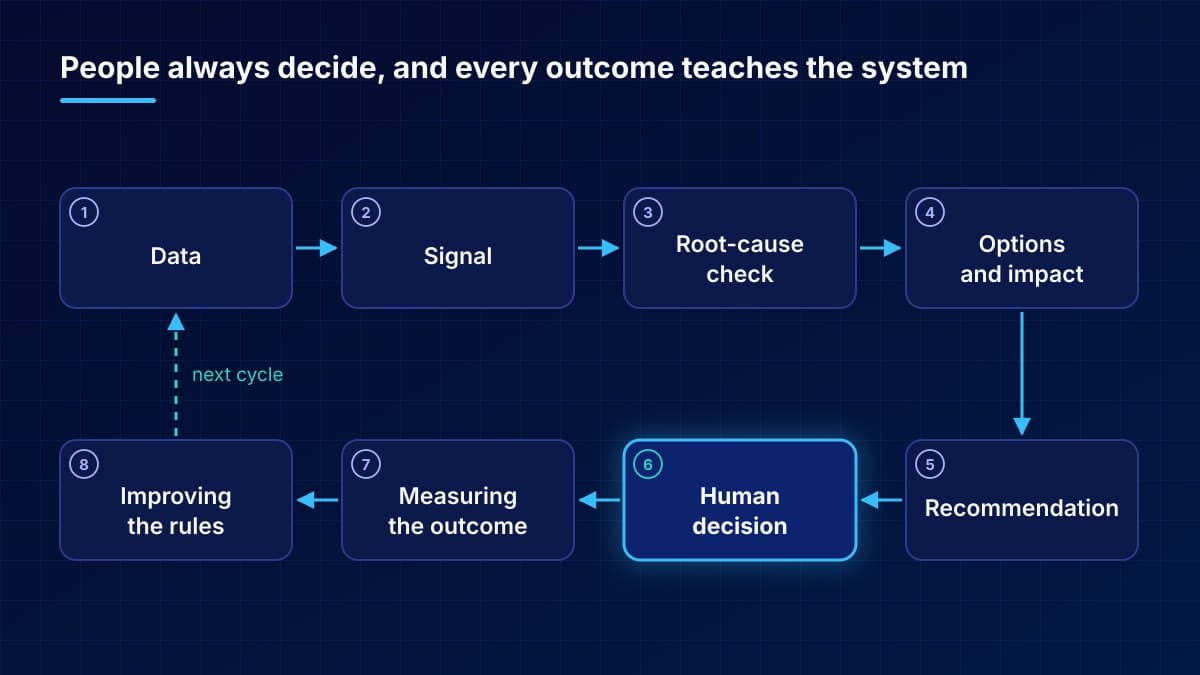
No AI director and no actions on its own. But every step can be checked: where the signal came from, why this cause, how the impact was calculated, who decided and how it ended. What makes the system useful is exactly this ability to check, not “intelligence”.
What we deliberately don't do at the start
These are not limits of the technology but our position. A lot of this is technically possible, but at the start it adds more risk than value:
- The system does nothing on its own. No automatic orders, price changes or instructions without a person.
- The language model does not calculate metrics. It explains them.
- No separate bots per department. One platform, different roles.
- No ROI before the baseline is measured.
- We don't use the system to assess employees. We care about the quality of decisions, not ranking people.
- We don't start with everything at once. One process, two or three scenarios, a clear result. Then we expand step by step, as with any rollout: a pilot first, then the next areas.
- We don't replace 1C, ERP or BI. We work on top of them.
Once the value is proven on one process, the limits can be lifted. One at a time, and deliberately.
Instead of a conclusion
AI in management is not a magic button. It is a discipline: clean data, verifiable calculations, clear decisions and honest measurement of results. It sounds more modest than an “autonomous business”. But it works.
What AI promise have you heard most often? And did it come true?
FAQ
So is AI in management not worth it?
It is worth it as an assistant that finds problems and calculates options. The decision and the responsibility stay with a person.
Why can't a language model be trusted to calculate metrics?
It works with text and can produce a plausible but wrong number. Analytics calculates the numbers on your data, and the model explains the result.
How do we check that the impact is real?
Record the baseline before the start and compare the pilot group with a control group. Then the result is measured on your data, not borrowed from someone else's case.