Claude + 1C via MCP: Talk to Your Accounting Database in Plain Language
Ask your 1C database questions in plain language, from a computer or a phone. How the Claude–1C connection via MCP works, what it can do and how your data stays protected.
2026-11-06
In short: Claude can work directly with your 1C database. You ask a question in plain language — “what were sales by store in October?” — and get an answer calculated from live data, not from a week-old export. It works in the browser, in the desktop app and on a phone.
Most companies have the data in 1C, but getting a quick answer out of it is hard. The report you need often doesn’t exist, building one takes time, and almost nobody uses 1C from a phone. So the manager waits for an export from the accountant or the developer, and the decision gets postponed.
Connecting Claude to 1C through the MCP protocol removes that middle step. Below: how it works, what it looks like in practice, how data access is controlled and which limitations to plan for up front.
How it works
MCP (Model Context Protocol) is an open standard that Anthropic published in 2024 for connecting AI assistants to external systems and data. In the Claude interface such a connection is called a connector.
The setup has three parts:
- An HTTP service in the 1C database. It exposes a few methods: run a query, fetch an object, find a document or a catalog item. It is published through a web server (Apache or IIS) that many companies already have configured.
- The MCP server. The intermediary between Claude and 1C: it tells Claude which tools are available, checks authorization, passes queries to 1C and keeps an access log. It runs on an existing company server — no separate rented server is needed.
- Claude. An employee connects the connector to their account once and then simply asks questions. Claude decides which data to request, retrieves it, does the calculations and writes the answer.
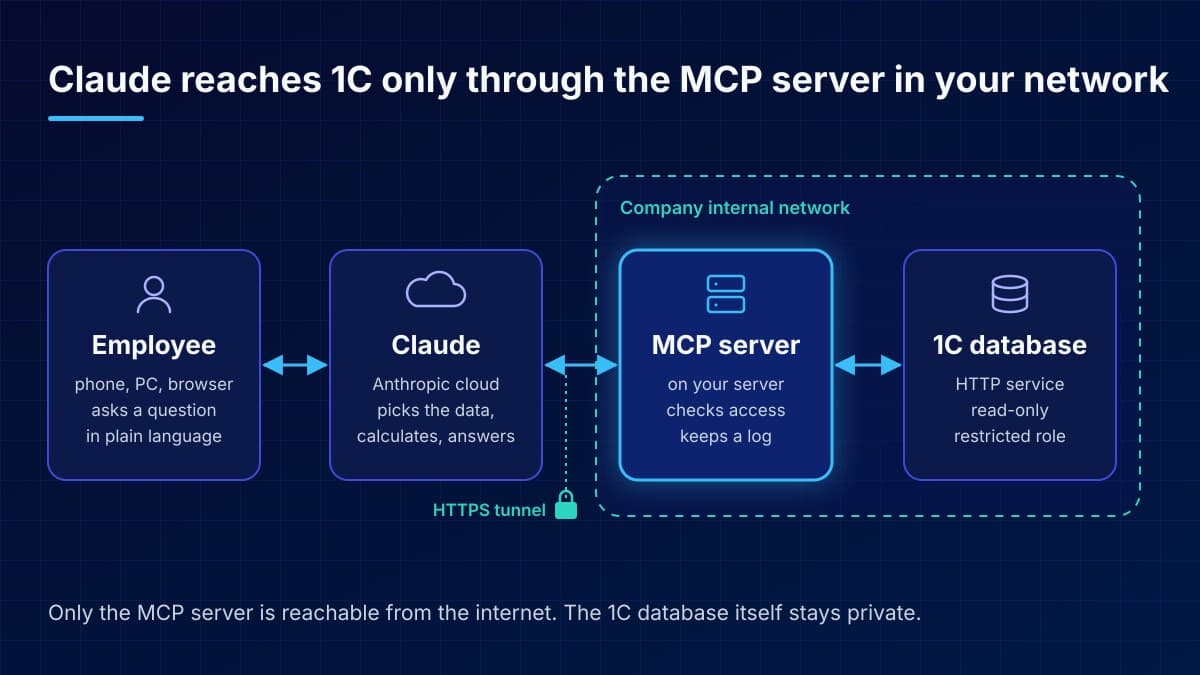
Claude connects to the MCP server from Anthropic’s cloud, not from the user’s device, so the server has to be reachable from the internet. The 1C database itself is not exposed: the MCP server is published through a secure tunnel (for example, Cloudflare), while 1C stays in the internal network.
The solution is not tied to one configuration. Claude first studies the database metadata — which catalogs, documents and registers exist — and only then builds a query. That is why it is designed for both standard and customized configurations.
What you can ask
The key difference from a regular report: the question doesn’t have to be anticipated. If the data is in the database, you can request it, compare it and explain it in one conversation, refining the question as you go.
Typical tasks:
- Sales: “Compare revenue by sales manager for October and September” — Claude adds up the totals, shows the difference and builds a table or chart.
- Warehouse: “Which products will run out in the next two weeks?” — compares stock with average sales.
- Customer balances: “Who owes us the most, and since when?” — collects debts by customer and due date.
- Purchasing: “Which items has the supplier raised prices on over the last six months?” — compares prices across receipts.
- Finding documents: “Find the invoice for ‘Alfa’ for roughly 12,000 MDL” — searches by approximate attributes.
- Variance analysis: “Why was the margin lower in October than in September?” — breaks the difference down by product, customer and discount.
The answer can be turned straight into a table, a chart or a short brief for a meeting. If other services are connected to the same Claude account (email, Google Drive, Notion), 1C data can be cross-checked against documents and correspondence in the same conversation.
What it looks like in practice
Two example conversations. The figures are illustrative, but the questions and the way the answers are built are typical for this kind of setup.
What were sales by store in October? Compare with September.
Claude ran 2 queries in 1C
Claude
October sales: 1,284,600 MDL, up 6.1% on September.
- Centru: 512,300 MDL (+9.8%)
- Botanica: 401,750 MDL (−3.1%)
- Rîșcani: 370,550 MDL (+12.4%)
Growth came mainly from Rîșcani and Centru. Botanica is the only store that declined. Shall I break Botanica down by product group?
Yes, Botanica please.
Claude ran 2 more queries
Claude
Almost the entire drop is in two groups:
- Household chemicals: −9,600 MDL (−14%)
- Tableware: −3,100 MDL (−6%)
The other groups are level with September. In household chemicals, 5 items were out of stock for 4 to 9 days. It looks like sales were lost because the goods weren’t there, not because demand fell.
Which products will run out at the main warehouse in the next two weeks at the current sales rate?
Claude ran 3 queries in 1C
Claude
I compared average sales over the last 30 days with current stock. Four items will run out in under 14 days:
- Thermal paper roll 57 mm — 120 pcs, enough for about 5 days
- T-shirt bag 30×55 — 2,400 pcs, about 8 days
- Stretch film 500 mm — 35 rolls, about 10 days
- Clear packing tape 48 mm — 210 pcs, about 12 days
There is already a supplier order for 400 thermal rolls due on 18 November — it will arrive after the current stock runs out.
How much should I order to cover a month?
Claude
To cover 30 days, taking current stock and the open order into account:
- Thermal paper roll 57 mm — 200 pcs
- T-shirt bag 30×55 — 6,600 pcs
- Stretch film 500 mm — 70 rolls
- Packing tape 48 mm — 315 pcs
I don’t create the order in 1C: in this setup I have read-only access. I can put the list into a table for you to send to the supplier.
Who benefits
The biggest winners are people who need numbers from 1C but don’t work in it every day:
- Owner and director — quick answers on revenue, margin, debts and stock from a phone, without calling accounting.
- Head of sales — analysis by manager, customer and product group without ordering a new report.
- Purchasing and warehouse — stock levels, turnover, supplier price trends.
- Accountant and finance — finding documents, reconciling figures, answering one-off management questions without manual exports.
- 1C developer — fewer “make me a one-off report” requests, more time to improve the system.
Security and control
The database stays with you, and Claude only receives the data needed for a specific answer, within the permissions you allow:
- Read-only. In the base setup Claude cannot create, change or delete anything in 1C.
- Restricted rights in 1C. Queries run under a dedicated 1C user. Its role can be restricted — for example, no access to payroll, HR or personal data.
- Authorization. Access to the connector requires sign-in. On Team and Enterprise plans the organization owner adds the connector and employees connect to it themselves.
- The database is not exposed to the internet. Only the MCP server is visible from outside — through a secure tunnel and HTTPS.
- Access log. The MCP server records which queries were run and when.
Worth knowing: data that Claude retrieves for an answer becomes part of the conversation and is processed in Anthropic’s cloud. On the Team and Enterprise business plans, Anthropic does not use such data to train its models by default. On personal plans (Free, Pro, Max) this depends on the user’s privacy settings, so for company data we recommend a business plan.
What to know up front
It is a powerful tool, but not a replacement for accounting or statutory reporting:
- Claude can make mistakes — for example, pick the wrong register or period. The interface shows which queries it sent to 1C, so key figures behind important decisions should be checked against a standard report.
- Answers are not instant. For a complex question Claude runs several queries in a row: first it studies the structure, then it collects the data.
- Very large data sets are not transferred in full. For multi-year analysis Claude calculates totals on the 1C side and works with aggregated data.
- Customized databases need a guide. Claude sees custom objects, but their meaning isn’t always clear from the name. A short description of the key objects noticeably improves accuracy.
- Database load. Queries run on the production server. If there is a lot of analysis, it can be pointed at a copy of the database.
- A Claude account is required. Custom connectors are available on all plans, but the free plan allows only one. For a team, the Team plan is more convenient.
How implementation works with AKDEV
We are already rolling this setup out for clients on different 1C configurations. The process goes step by step:
- Audit. We review the configuration, platform version and web publication, and agree with you which data to open and which to keep closed.
- HTTP service in 1C. We add the service to the database and create a dedicated 1C user with restricted rights.
- MCP server. We install it on your server, publish it through a secure tunnel and set up authorization and logging.
- Connecting Claude. We add the connector to the account or organization and show employees how to ask questions.
- Pilot. We collect real questions from your staff, check the answers and extend the object descriptions where Claude gets things wrong.
- Support. We monitor the server, update the service when the configuration changes and add new scenarios.
Sources: Introducing the Model Context Protocol, Custom connectors using remote MCP, Get started with connectors, Is my data used for model training?
FAQ
How is this different from a regular AI chat?
Without a connector, the AI knows nothing about your database and can only talk in general terms. With the connector, Claude answers from the current data in your 1C at the moment you ask.
Does it work from a phone?
Yes. A connector added to the account is available on the web, in the desktop app and in the Claude mobile app for iOS and Android.
Can we ask in Romanian and Russian?
Yes, Claude works in both languages. You can ask in Romanian even if the database itself is kept in Russian.
Do we need to change our 1C?
Your existing accounting logic stays the same. The only addition is an HTTP service for reading data. Platform version and web server requirements are checked during the audit.
What if we stop using Claude?
The data stays in 1C. MCP is an open standard, so the same server can be connected to other AI tools that support it.
How much does it cost?
It depends on the configuration, the infrastructure and the number of users. After a short audit we prepare a commercial proposal. The Claude subscription is paid separately, directly to Anthropic.
You don’t need to replace 1C: modernizing processes through modular integration