You Don’t Need to Replace 1C: How to Modernize Business Processes Through Modular Integration
How to keep 1C as the accounting core while moving warehouse, CRM, procurement, approvals and AI into modern standalone modules without a full ERP migration.
2026-06-19
Summary: companies often try to solve operational problems by replacing the entire ERP. In practice, a faster and safer approach is to keep 1C as the accounting core and move the most painful business processes into modern standalone modules.
The problem is not always 1C itself
In many companies, 1C remains the central system of record. It handles accounting, documents, stock, customers, sales, and procurement. For many organizations, this is normal: the accounting team knows the system, reporting is already connected, and the database contains critical history.
The problem starts when business processes outgrow the format of a traditional accounting-centric system.
Typical examples:
- warehouse teams need real-time stock and movement data;
- sales teams work across Excel, Telegram, and personal notes;
- procurement approvals happen in message chains;
- finance directors manually collect budgets and plan-vs-actual reports;
- management cannot see the current picture without exports and calls.
At this point, companies often jump to a dangerous conclusion: “We need to replace the entire ERP.” But a full migration is expensive, risky, and slow.
Full ERP migration is rarely the right first step
Replacing the whole ERP usually means:
- migrating historical data;
- rewriting business logic;
- training employees;
- running two systems in parallel;
- risking disruption of daily operations;
- spending months or even years on implementation.
For mid-sized companies, this is often too heavy. Especially when the accounting part of 1C works well, while the real pain is concentrated in specific areas: warehouse, CRM, procurement, approvals, budgeting, or analytics.
A more practical path is modular modernization.
What modular integration means
Modular integration means keeping 1C as the system of record while building new business capabilities around it as separate applications.
A simplified architecture looks like this:
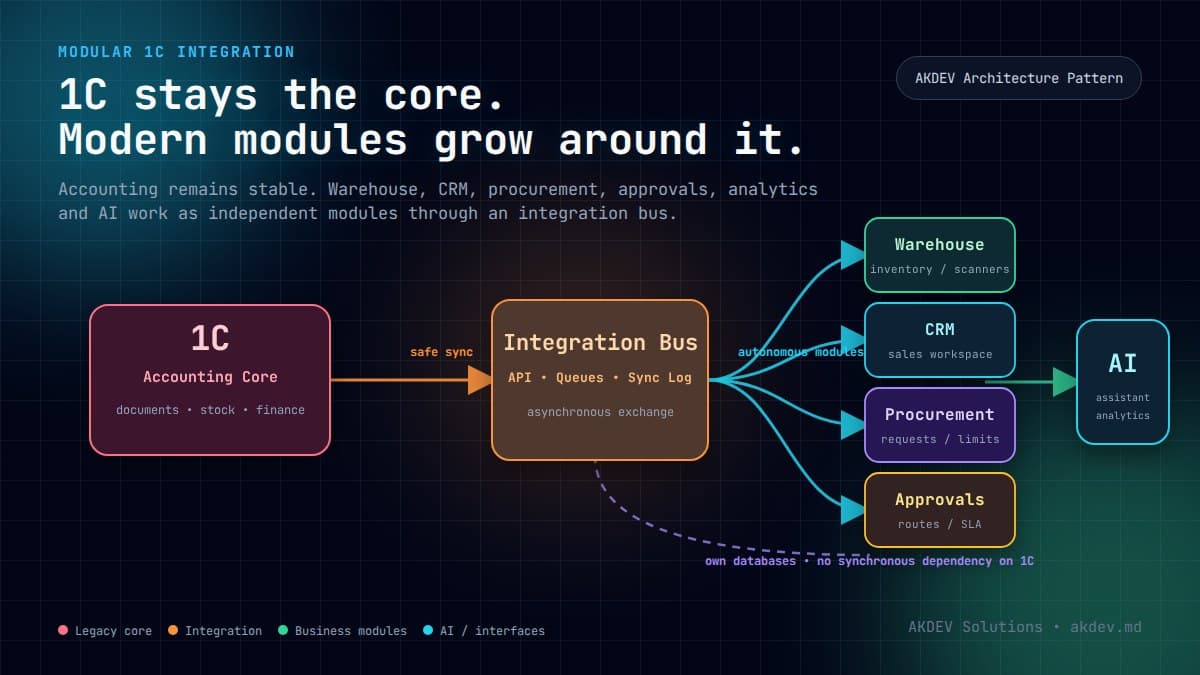
We do not break the existing system. We add a new layer around it: faster, easier to use, scalable, and focused on a specific business process.
Which modules are usually worth separating first
1. Warehouse and inventory
If warehouse operations are slow, data is delayed, and employees constantly verify stock manually, a dedicated warehouse module can deliver quick value.
It can support mobile devices, scanners, roles, reservations, transfers, and live stock visibility. 1C remains the accounting source and synchronizes through the integration layer.
2. CRM and sales
Sales teams often do not lack data. They lack a proper workspace. Customers are in 1C, deals are in managers’ heads, communication is in Telegram, and tasks are in Excel.
A separate CRM module can combine customers, contact history, commercial offers, activities, overdue payments, tasks, and management reports in one interface.
3. Procurement and supply
Procurement should not live in chat threads. Requests, suppliers, prices, approvals, and statuses need transparency.
A procurement module can manage requests, approval routes, limits, price history, and stock links. 1C receives the structured result.
4. Approvals and document workflow
When every approval follows the pattern “send it to me in chat, I’ll check it,” the company loses control. It becomes unclear who is blocking the process, what the current status is, and where the final decision lives.
A dedicated approval module solves this through roles, routes, SLA rules, notifications, and an audit log.
5. Budgeting and plan-vs-actual
Financial planning often remains in Excel even in companies that use 1C. The reason is simple: budgeting requires scenarios, versions, limits, approvals, and flexible analytics.
This module can be built separately while keeping a live connection to actual data from 1C.
Key principle: the new module should not synchronously depend on 1C
A common integration mistake is turning the new interface into a thin wrapper over 1C. The user clicks a button, the system waits for 1C, 1C responds slowly — and the new module becomes slow too.
The better approach:
- the new module has its own database;
- critical operations work autonomously;
- data exchange with 1C goes through an API, queue, or integration bus;
- if 1C is temporarily unavailable, the module continues to work;
- synchronization catches up when the connection is restored.
This is especially important for warehouse, sales, and mobile workflows where delays directly affect employees.
Where AI fits
AI should not be decoration on top of chaos. If data is scattered across Excel files, chats, and verbal agreements, AI will only summarize the mess more elegantly.
But once data is structured in a modular architecture, AI becomes a useful working layer:
- helping sales managers prepare commercial offers;
- highlighting customers with payment risk;
- explaining plan-vs-actual deviations;
- suggesting the next step in a deal;
- answering management questions about sales, stock, or finance.
AI does not replace ERP. It works on top of a properly structured business operating system.
Why this is cheaper and safer
Modular modernization has several advantages.
The company does not stop operations. Existing 1C workflows continue, while the new module is introduced around one specific process.
The budget becomes clearer. Instead of one large “replace everything” project, the business selects a module with measurable ROI.
Results arrive faster. The first module can be launched iteratively: MVP, pilot, then expansion.
Risk is lower. If the module requires adjustments, it does not break the entire accounting core.
A practical implementation path
A typical path looks like this:
- Choose the most painful business process.
- Map current roles, data, and manual operations.
- Define what stays in 1C and what moves into the new module.
- Build an MVP with the minimum useful feature set.
- Configure integration and exchange logging.
- Launch a pilot with one team or branch.
- Expand the module after validating the result.
This approach does not require believing in a two-year transformation plan. It requires choosing one real problem and solving it properly.
Conclusion
1C does not always need to be replaced completely. In many cases, it is better to keep it as a stable accounting core and gradually move problematic processes into modern modules.
This path avoids sudden disruption, protects the business from unnecessary risk, and still gives the company modern interfaces, mobility, analytics, automation, and AI capabilities.
For business, this is not an “ERP revolution.” It is engineering modernization: module by module, process by process, with a clear result at every stage.
CTA: If you have a process that no longer fits into 1C, Excel, and chat messages, AKDEV can help identify the first module to modernize and design a safe integration with your existing system.