The Cost of a Bad Website: How an Outdated Site Kills Sales and Why 1C Integration Is Not a Luxury
Why an outdated website without support and 1C integration costs you money every day. Real stories of lost sales and how modern integration restores control.
2026-05-12
Your Website Is Your Storefront. What If It's Falling Apart?
Imagine a shop in central Chisinau. Dirty window, crooked sign, the register can't scan half the items, and the salesperson shows up once a week. How many customers walk in? How many buy something?
That's what most outdated websites look like — built hastily years ago, never updated, admin password long forgotten. Except online it's worse: the customer can't see your smile, they only see what the website tells them.
- Customer visits your site — product is "out of stock" (it's actually on the shelf)
- Customer places an order — a week later they find out the item doesn't exist (inventory is stale)
- Customer tries to pay online — error 500
- Customer writes to chat — nobody answers (chat was disconnected a year ago)
- Customer goes to a competitor — and never comes back
This isn't hypothetical. This is what clients bring to us after losing 30-50% of their online sales.
Four Typical Pains of Unsupported Websites
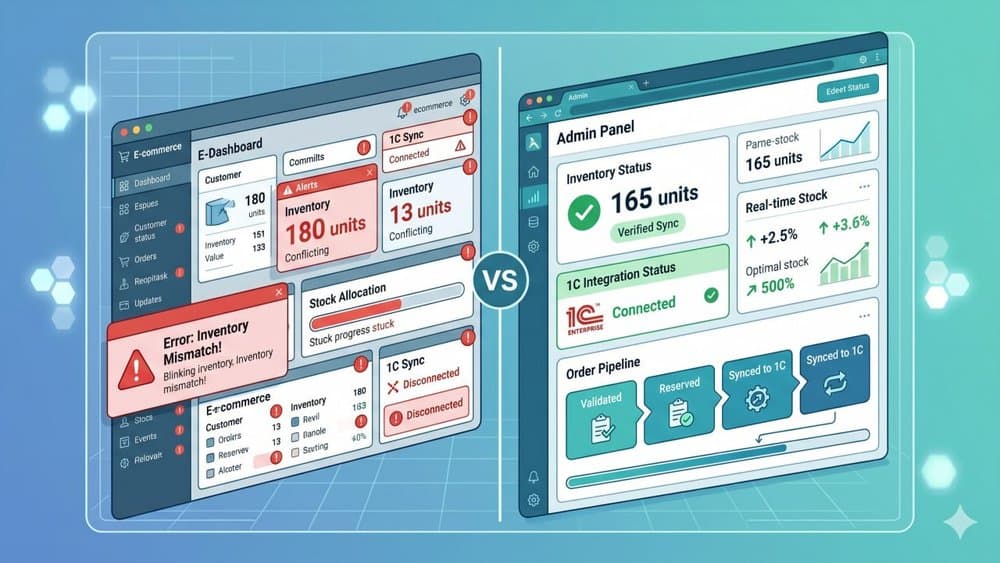
1. Inventory Never Matches Reality
Classic scenario. The website says "15 in stock." The manager confirms the order. The warehouse worker checks the shelf — empty. Or the opposite: 100 units in stock, but the site says "out of stock."
Why? Because the website isn't connected to 1C. Inventory is updated manually, once a day or once a week. Twenty units sell during the day, but the website still shows yesterday's number.
The result:
- Over-selling — you sold what you don't have. Customer waits, gets angry, complains
- Lost sales — customer didn't buy because the site showed "out of stock". The item exists, but the sale is lost
- Reputation — customers stop trusting your site and call the office to "check if it's really available"
In our experience, inventory discrepancies cause 15-25% lost online sales for distributors without 1C integration.
2. Site Goes Down — And There's Nobody to Call
New PHP version released — site crashes. SSL renewed but not updated on the server. Hackers DDoS the site. An admin module update breaks everything.
When the site is down, the business simply loses money. Every hour of downtime means lost orders. But without a support contract, you can't just "call and fix it." You have to find that freelancer who built the site 3 years ago. And they say: "I don't do that anymore" or "That'll be $500 plus a week." Or their contact is simply lost.
Typical scenario: site is down for 3 days. Competitors pick up your customers. You don't just lose those days' sales — you lose trust. Customers remember: "their site is always down."
3. No Documentation — Everything Is "Word of Mouth"
The site was built by a freelancer from an agency that closed down. Logins and passwords are in his head. FTP details — he remembers but never wrote them down. How to update products — "just click here and there in the admin." When he disappears, you're left with a site nobody can administer.
Sound familiar? This is so common we've stopped being surprised. No documentation, no support, no understanding of how anything works — it's not just inconvenient. It's a business risk.
4. 1C Integration Exists, But It Doesn't Work
This scenario is just as common: the site was once connected to 1C, the integration worked, but over time it broke. 1C was updated — stock stopped syncing. Hosting was changed — orders stopped being created. Someone "fixed" the database — now prices on the site don't match the accounting system.
What's the problem? The original integration was built "however it worked": no documentation, no error handling, no monitoring. It worked "while everything was fine," but at the first failure — it collapsed. And there's nobody to fix it — that developer left, the code has no comments, the logs are empty.
What we do: audit the existing integration — find what syncs, what gets lost, where errors occur. We add error handling, logging, automatic failure alerts. Rewrite critical nodes on a reliable architecture — REST API or RabbitMQ. Restore synchronization and add monitoring so we know about the next failure before you do.
The Financial Impact: Let's Do the Math
Take an average Moldovan distributor with €100,000 monthly turnover and 30% online sales.
- €30,000/month — online sales
- 20% lost due to bad inventory data — €6,000/month
- 3 days of site downtime per month — another €3,000
- Lost sales due to poor UX — up to €5,000
Total: €14,000 in losses per month. That's €168,000 per year — the cost of a full ERP implementation from scratch.
And these are just direct losses. Reputational damage stays with you for years.
What We Do and How It Works
AKDEV doesn't "make websites." AKDEV builds working sales systems where the site is not a storefront — it's a full sales channel.
1C Integration — Real-Time Inventory
We connect your website to 1C via REST API or RabbitMQ. Stock levels sync every 5-15 minutes (or per event — on every sale). The customer sees exactly what's in the warehouse. Over-selling is eliminated.
How it looks in practice:
- Manager ships goods in 1C → stock decreases on the site in 2 minutes
- Warehouse receives stock in 1C → items appear on the site automatically
- Customer buys on the site → order is created in 1C without manager intervention
- Prices, promotions, wholesale discounts — all from 1C, no double entry
Result: the customer always sees the truth. Managers don't waste time reconciling inventory. Sales aren't lost to "out of stock" errors.
Support — Not "Call If Something Breaks" But SLA
Every AKDEV client gets:
- SLA contract — response and resolution times are guaranteed
- 24/7 monitoring — we know about problems before you do
- Telegram channel — status updates, maintenance windows, changelog
- Documentation — all passwords, diagrams, instructions in one place
- Dedicated engineer — one person who knows your project inside out
When your site goes down at 3 AM, we're already fixing it — not waiting until Monday morning.
Modern Stack — No Surprises
We don't use obscure "homegrown CMS" that nobody can maintain. Our standard stack is NestJS, Angular, PostgreSQL. Or Next.js for content sites. Or Flutter for mobile apps. All with CI/CD, automated tests, monitoring.
If tomorrow you want to extend functionality or hire another team — that's not a problem. Code is documented, architecture is clear, repository is on GitHub.
Client Stories: Not Fun to Brag, But Necessary
A Moldovan construction materials distributor came to us with a 7-year-old site. No updates, no 1C integration. Managers manually copied orders from the cart into 1C — with errors. Customers complained that items on the site weren't actually available.
What we did:
- Completely rewrote the site on NestJS + Angular
- Connected 1C integration via REST API
- Built a client portal with order history
- Set up monitoring and SLA support
Results after 3 months:
- Order errors — from 8% down to 0.3%
- Order processing time — from 2 hours to 15 minutes
- Online sales grew by 40%
- Customers stopped calling to ask "is it really in stock?"
Another example: a retail chain. Their site crashed during a routine update and stayed down for 5 days. The old dev team said "we don't do this project anymore." We were found through referrals. In 2 days we restored the site, in a week we migrated it to a new infrastructure. That was 3 years ago — they're still with us.
We don't like saying "hundreds of happy clients" — we have real projects with real results. After every project, we ask for feedback. And yes — we get referrals.
The Cost of Doing Nothing
Calculate how much your current site costs you per month: lost sales, manager time on manual work, downtime, lost customers, stress.
Now compare that with the budget for a modern site with integration and support. The difference is usually less than one month of losses. Everything after that is pure savings and growth.
Where to Start
If you recognized your site in this article — let's just talk. We'll do a free audit: show you what's wrong, how much you're losing, and how to fix it.
hello@akdev.md or +373 68 733 331. No commitment, no sales pitch — just a conversation.